Every Tax Lot & Condo Unit
Review more than 1.1M NYC tax lots and condo units across five boroughs, with condo units resolved to their building and municipal records refreshed monthly.
PearlAudit Enterprise gives acquisition teams instant property intelligence across New York City tax lots and condo units. Replace repeated portal-by-portal assembly with source-cited dossiers your analysts can review on demand.
Sample output
Every dossier is designed for a decision-maker who needs the answer and an analyst who needs to verify it. Preview real sample pages before you request a call.
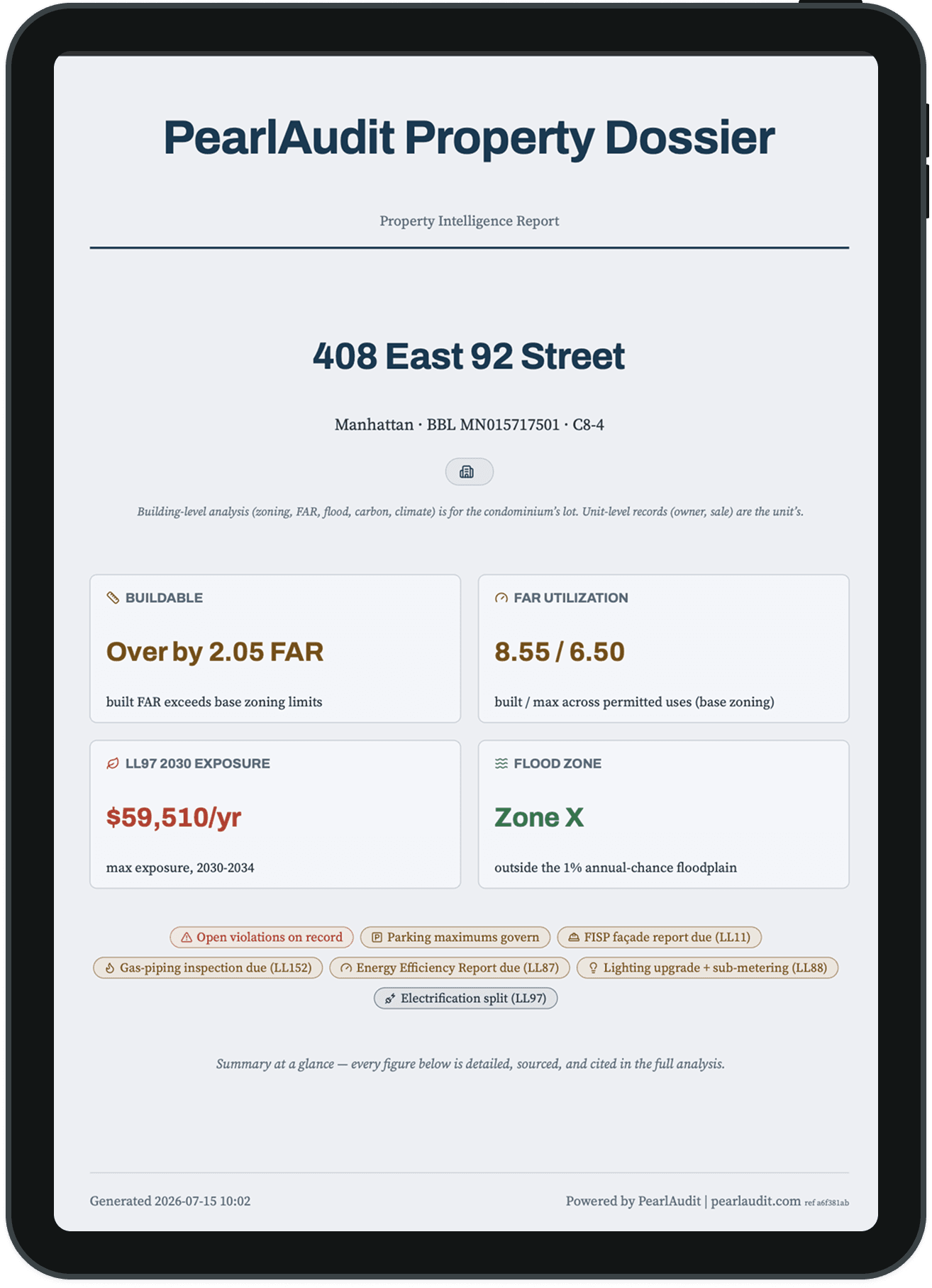
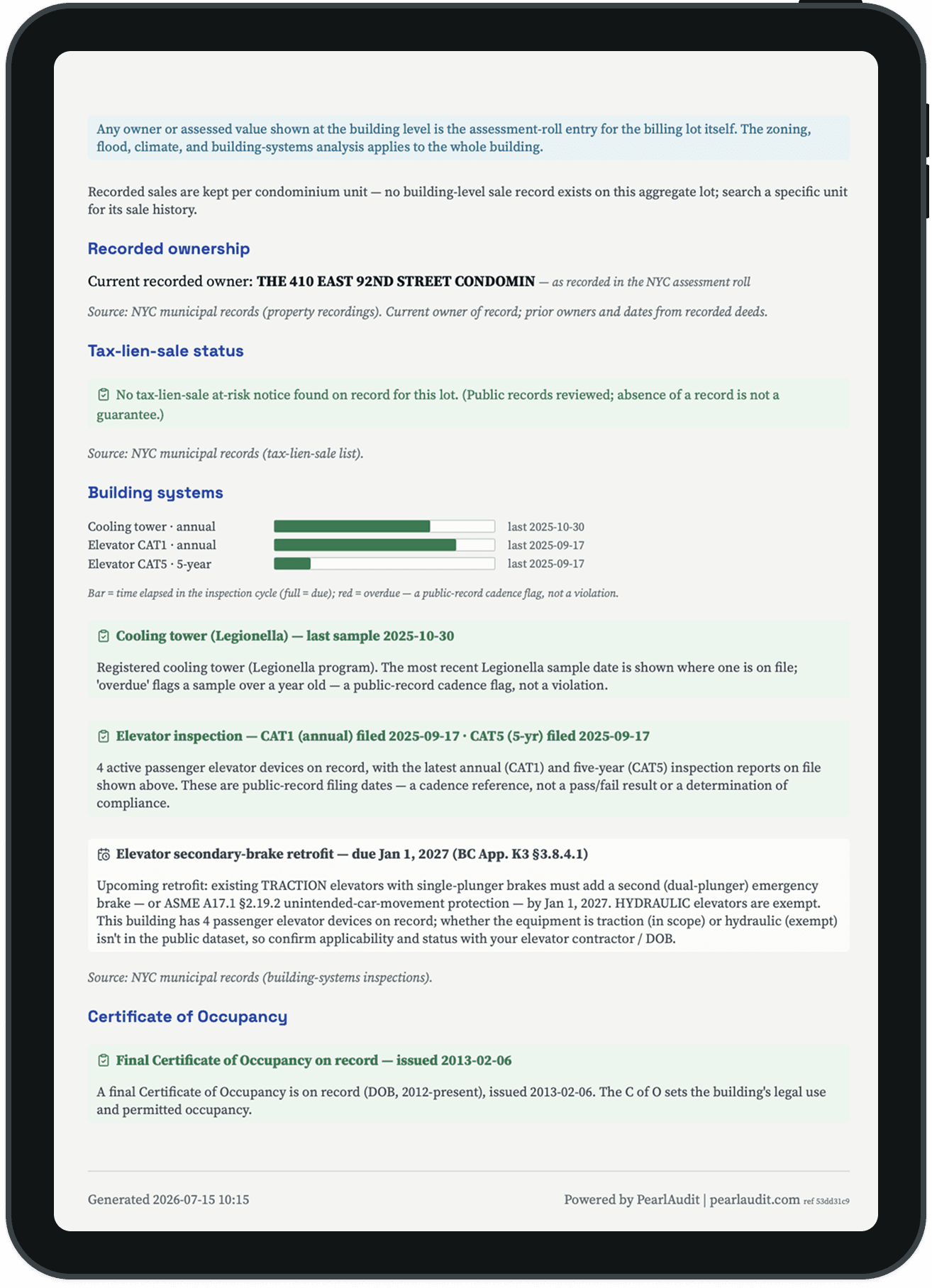
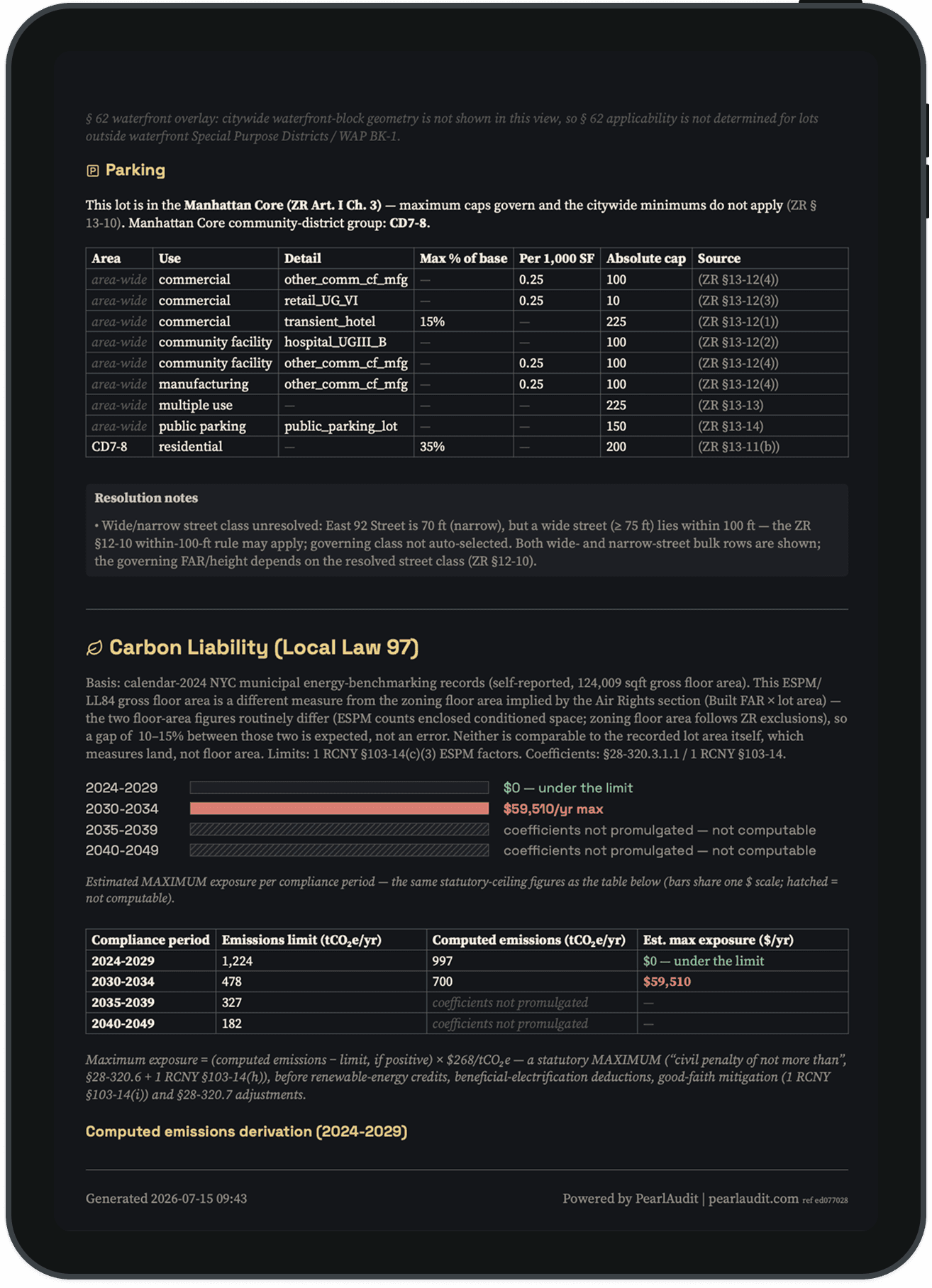
Three sample pages, one per theme — the theme changes the typesetting, and each of these is a different page of a different property.
Sample pages, one per report theme. A tailored demo uses a property from your workflow.
Every deal starts the same way. An analyst opens one government portal for zoning, another for title, another for violations, another for flood maps, another for assessed value — a dozen separate sites, each with a different interface and format. The reviewer is then left to reconcile the records and reconstruct what was checked.
PearlAudit assembles the covered public records into one source-cited review, while keeping the limitations visible.
Your team toggles between 8–12 government websites per property. Each has different interfaces, different formats, different update schedules. Mistakes happen when analysts are tired, rushed, or new.
When a deal goes wrong because someone missed an (E) Designation or a landmark restriction, there’s no record of what was checked. PearlAudit timestamps every dossier and tracks every query.
Adding volume to a portal-by-portal process adds more repetitive assembly. PearlAudit gives each analyst the same starting record and preserves the source trail for review.
Team capabilities remain included. Enterprise adds negotiated volume and limits, contract terms, dedicated onboarding, and account support for portfolio-scale programs.
Review more than 1.1M NYC tax lots and condo units across five boroughs, with condo units resolved to their building and municipal records refreshed monthly.
Instant flood risk classification for any address — federal flood-zone codes and Base Flood Elevation, plus forward-looking stormwater and sea-level-rise projections.
Built vs. allowed Floor Area Ratio with remaining development potential calculated automatically. Identifies overbuilt properties and untapped vertical capacity.
Screen cited public records for (E)-Designations and nearby remediation or cleanup sites. This is a records review, not an environmental assessment.
Bring ownership and sales, value, liens, tax benefits, legal use, building systems, rent-stabilization counts, and cited distress signals into one review.
Review other buildings recorded to the same owner, portfolio-health counts, and adjacent lots. This recorded-name linkage does not determine beneficial ownership or common control.
Individual landmark designations and historic-district boundaries are checked against the parcel and printed in the dossier. Where landmark status makes unused floor area not as-of-right, the FAR analysis says so and cites the rule rather than reporting free air rights.
Professional property intelligence reports generated on demand. Formatted for client meetings, investment committee presentations, and offering memoranda attachments.
One-page property briefings by USPS First Class are on the roadmap. Delivery tracking is not currently available; contact us if mailed outreach matters to your workflow.
Type any NYC address and see instant, validated suggestions covering every address in the five boroughs. No typos, no failed lookups.
Screen up to 500 properties by CSV or pasted BBLs and addresses, download a spreadsheet, and review recorded-owner rollups. Available to Team-and-up in-app and through the API.
Open bulk screeningUse the key-authenticated REST API to integrate property intelligence, bulk screening, and asynchronous completion webhooks. The OpenAPI reference and interactive sandbox are live.
Open the API referenceSend property-monitoring events to your CRM or internal tools as HMAC-signed webhooks. Step-by-step recipes cover automation platforms and custom receivers.
Read the integration recipesWhite-label every dossier with your firm's logo, colors, and contact information. Dossiers look like they came from your team, not a third-party vendor.
Search addresses individually in-app or via the REST API, or upload a CSV / paste a list of BBLs and addresses on the bulk screening page. PearlAudit geocodes and validates every entry against authoritative NYC address records.
Each property is checked across covered zoning, air-rights, flood, compliance, environmental, value, and ownership records, with citations kept beside the findings.
Results are presented in a sortable dashboard. Filter by FAR availability, flood risk, environmental flags, or assessed value. Focus on properties that meet your criteria.
Download individual property dossiers as PDFs or bulk results as a spreadsheet, then route the cited record into your existing review process.
Manual diligence spans multiple portals and repeated document assembly. PearlAudit automates that starting record so analysts can spend more time verifying exceptions and evaluating the deal.
Consistent, source-cited checks make covered records easier to review. PearlAudit supports professional judgment; it does not replace legal, title, zoning, or environmental review.
Generate a first-pass property record while a conventional multi-source review is still being assembled, then decide where deeper diligence deserves attention.
All traffic encrypted in transit (TLS 1.3). API keys are stored hashed, bound to the account that issued them, bounded by that account’s tier and a per-minute rate budget, and revocable instantly; webhooks are HMAC-signed. We’ll complete your vendor security questionnaire and sign a DPA on request.
PearlAudit analyzes public government data only — no third-party PII is sold or shared. We store your account’s own search and download history to power your audit trail; that activity stays private to your team.
The property intelligence is public, read-only government data, the same for every customer. Private account state such as search history, API keys, and branding is access-controlled and scoped to your account.
Every search, every dossier, every download is timestamped and logged against the account that ran it, so a reviewer can reconstruct what was checked and when. Attribution is per account, not yet per analyst — see Accounts & Seats below.
PearlAudit does not hold a SOC 2 or ISO 27001 certification today. What we do hold is written down in full on our security overview — controls, subprocessor categories, retention, and what we will sign. Send your questionnaire whenever you are ready.
Enterprise agreements start at $2,500 per month and scale based on team size, query volume, and integration requirements. Every agreement includes dedicated onboarding, priority support, and custom report configuration.
| What’s Included | Details |
|---|---|
| Dossier Volume | Custom (typically 1,000–10,000/month) |
| Accounts & Seats | One login per account today — per-analyst seats and roles are not yet available. Tell us your team size before we scope a contract. |
| Portfolio Monitoring | Up to 500 watched properties; alert delivery per contract |
| API Access | REST API — key-authenticated, documented + try-it sandbox (pearlaudit.com/v1/docs) |
| Bulk Screening | CSV upload + API, up to 500 properties per job |
| Report Branding | Your logo, colors, contact info |
| Support | Dedicated account manager, priority support |
| Onboarding | 1:1 setup call, team training session |
| Contract | Annual or multi-year, invoiced quarterly |
Request a tailored demo, a capabilities deck, or a pilot conversation. A person will reply—no account and no automated sales sequence.
NYC municipal property records (over 1.1M tax lots and condo units, resolved to their building), federal flood maps, and validated NYC address coverage. We continually expand municipal-records coverage.
Yes — the REST API is live: key-authenticated, with an OpenAPI reference and an interactive try-it sandbox at pearlaudit.com/v1/docs. Endpoints cover the full property-intelligence object (/query), the typeset PDF dossier (/report), and async bulk batch screening (/bulk — up to 500 properties per job, with optional HMAC-signed completion webhooks). Each key carries a tier and a per-minute rate budget. Contact us for a key and your rate limit.
Recorded documents and litigation refresh weekly; violations, compliance records and the parcel roll refresh monthly; federal flood-zone data updates as new maps are issued. Every dossier prints a "Data as of" date beside the figure it applies to, so your team can see the vintage of each record rather than trusting one blanket claim. For a live deal, the dossier is the assembled starting record — filing status still gets confirmed at the agency before you rely on it.
Not yet, and this is the honest state of it: an account today is a single login, so a team shares one set of credentials and the audit trail attributes activity to the account rather than to the individual analyst. Per-analyst seats, roles and SAML SSO are the next thing we are building on the account layer. If a contract depends on either, tell us during scoping and we will give you a date rather than a maybe.
We do not hold a SOC 2 or ISO 27001 certification today, and we would rather you hear that from us than from your questionnaire. Our security overview at pearlaudit.com/security sets out the controls that are in place, the categories of subprocessor we use, retention and deletion timelines, and what we will sign. We complete vendor security questionnaires and sign a DPA on request.
PearlAudit currently covers New York City exclusively. Geographic expansion is on our roadmap — if your firm operates in other markets, contact us to discuss timeline and priority.
Enterprise pricing, contract term, invoicing cadence, and any procurement requirements are agreed during the sales process. Tell us if your vendor-onboarding process requires a specific payment method or document.
No. You can begin with our self-serve plans — including a free tier for occasional lookups, a one-time single-dossier purchase, and monthly Pro and Team plans — and move to an Enterprise agreement when your volume, seat count, or integration needs grow.
Yes. We can scope a pilot around a representative set of properties so your team can evaluate the records, workflow, and output quality before discussing a longer-term agreement.
See how PearlAudit assembles a source-cited starting record for a property from your workflow.
Request a tailored demoNo account is created. A person will reply about your request.